Showing posts with label science. Show all posts

Tuesday, February 26, 2013

New Maps Show Worldwide Coral Bleaching by 2056 - Global Warming?

In a study funded by Pacific Islands Climate Change Cooperative, new maps show the potential effect of worldwide coral bleaching by 2056.

Corals in Polynesia

The mass bleaching is caused by higher-than-normal sea temperatures. Light kills the algae that reside within the corals, giving them the bright colors as well as nutrition. The findings of the study emphasize that without significant reductions in emissions, most coral reefs are at risk.

The maps utilize spatial variability, showing the effect of temperature increases on a global scale. This temperature increase (also called Global Warming) could be the result of human development, industrialization and pollution. This wall map, How Man Pollutes His World, published by National Geographic, shows how everything we do affects the environment.
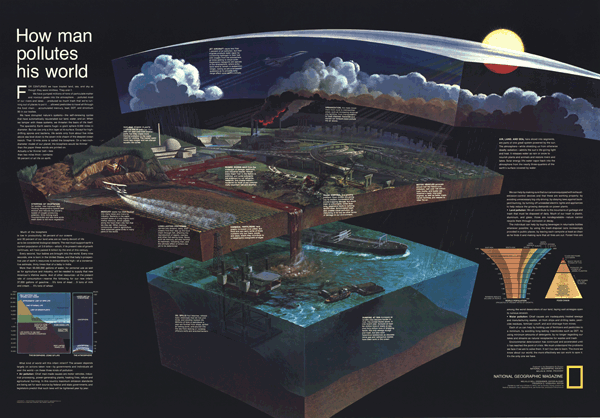
How Man Pollutes His World Wall Map
The use of maps illustrate the point that the world is changing – and quickly! What will the world look like in 2056? How will the bleaching of coral reefs affect the ocean ecosystems in those areas? Using geospatial technology allows us to not only collect, analyze and compare large amounts of data, but also make predictions about how the world will change. Maps help us explore and understand our world, after all, we only have one Earth.

Tuesday, January 29, 2013

Riding the Largest Waves: from California to Portugal

In the wake of Garrett McNamara possibly breaking his own world record for the largest wave surfed, mapsales.com takes a look at geographical features that cause large waves, and where to find them!


How do Waves get so Large?

Zoom in on this Portugal Wall Map to find where McNamara set his world record in 2001: Narare, Portugal.

“There is an underwater canyon 1,000 feet deep that runs from the ocean right up to the cliffs. It’s like a funnel. At its ocean end its three miles wide but narrows as it gets closer to the store and when there is a big swell it acts like an amplifier,” McNamara explains. The ocean floor is far from flat; geographical features play a large role in determining how waves crash and how large they can get. Zoom in on this World Physical Ocean Floor Map to see the variations of our oceans!


His newest record, possibly over 100 feet, took place yesterday also in Praia do Norte, Nazare, Portugal. The previous world record by mark Parsons occurred in Cortes Bank, California. California is well-known for their surfing competitions, including the Mavericks Invitational big-wave competition, which restarted this year after a series of waves crashed spectators in 2010. Even wave-watching can be dangerous when the waves range from 20 to 90 feet!

While previous world records have been documented all over the world, Portugal may increase in popularity for thrill-seeking surfers looking for the largest waves. Take a look at this Portugal Wall Map to plan your next trip!


Previous World Records for Tallest Wave Surfed
1. Garrett McNamara, 78 ft wave
Nazaré, Portugal in November 2011
2. Mark Parsons, 77ft wave
Cortes Bank, California in January 2008
3. Pete Cabrinha, 70ft wave
Jaws Beach, Maui in January 2004
4. Brag Gerlach, 68 ft wave
Todos Santos, Mexico in December 2005

Shop Wall Maps!

Friday, January 4, 2013

Oddities of the Frozen World


As much as maps can help us understand information about geography, science, and nature, there is still much about our world that remains mysterious.  mapsales.com shares some awe-inspiring oddities of the “frozen world”.


Near the planet’s poles and in other cold regions, there are unusual water formations that are sure to take your breath away. 


The unbelievably blue river in Greenland is caused by the melting Petermann Glacier.  When the glacier melts, it fills low-lying areas with beautifully blue waters.  The melting and filling patterns change from season to season in expected ways.  The Blue River is a popular destination for kayakers because of its fluctuating flows and its stunning water. 


Ice caves like this one are caused by natural processes involving glaciers, melting, and sediments.  But knowing the science behind it doesn’t take away from the ice cave’s majesty.  This particular ice cave is located in Skaftafell, Iceland.  It is a temporary structure that is only accessible through a 22-foot entrance along the shoreline. 


The frozen wave in Antarctica is a structure that needs to be seen to be believed.  Discovered in 2007, it was initially thought that a wave was flash frozen by the sub-zero temperatures and perfectly preserved.  But the presence of blue ice in the wave has led scientists to believe that the structure was actually built slowly over time. 


If you watch movies like Titanic, you may assume that all icebergs are blue or clear.  But sailing around the Southern Ocean will give you different idea.  You will find icebergs with yellow, brown, blue, and green stripes in the cold waters around Antarctica.  This phenomenon occurs when the icebergs interact with salt and fresh waters.  Lapped by the waves, and blown by the winds, icebergs can be painted with amazing stripes of different sizes and textures.


Thanks for reading this article. If you got this far, you probably liked it so please share it with your friends!