Showing posts with label GIS. Show all posts

Thursday, August 22, 2013

GbBIS at Oracle OpenWorld 2013

Join us at Oracle OpenWorld 2013!

Oracle OpenWorld in San Francisco 2013 features thousands of sessions from which attendees can choose, including keynotes, technical sessions, demos, and hands-on labs. Hundreds of exhibitors (including us!) will be on hand to share what they’re bringing to the leading edge of Oracle technology.

Look for GbBIS at booth 200!

GbBIS --Geography-based Business Information Solutions-- provides accurate postal data and mapping geographies, geo-data and analytics to manage growth and business operations. For a better understanding of customers, markets, optimal territories and site selection, GbBIS provides the geographic, demographic and location intelligence you need. 

And, you can still register below!


Tuesday, February 26, 2013

New Maps Show Worldwide Coral Bleaching by 2056 - Global Warming?

In a study funded by Pacific Islands Climate Change Cooperative, new maps show the potential effect of worldwide coral bleaching by 2056.

Corals in Polynesia

The mass bleaching is caused by higher-than-normal sea temperatures. Light kills the algae that reside within the corals, giving them the bright colors as well as nutrition. The findings of the study emphasize that without significant reductions in emissions, most coral reefs are at risk.

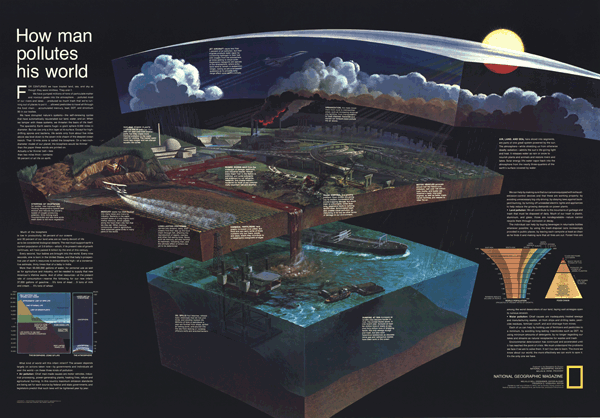
The maps utilize spatial variability, showing the effect of temperature increases on a global scale. This temperature increase (also called Global Warming) could be the result of human development, industrialization and pollution. This wall map, How Man Pollutes His World, published by National Geographic, shows how everything we do affects the environment.

How Man Pollutes His World Wall Map
The use of maps illustrate the point that the world is changing – and quickly! What will the world look like in 2056? How will the bleaching of coral reefs affect the ocean ecosystems in those areas? Using geospatial technology allows us to not only collect, analyze and compare large amounts of data, but also make predictions about how the world will change. Maps help us explore and understand our world, after all, we only have one Earth.

Thursday, February 21, 2013

Is GIS the Future? Prepare for New Jobs with Educational Wall Maps


GIS stands for Geographical Information Systems, systems designed to capture, manipulate, and present all types of geographical data. It combines technology, geography and data in ways that are quickly changing all aspects of life and how we approach the world. But are our children prepared to become the experts in this field? mapsales.com takes a look at the future job report, GIS innovations and educational wall maps to find out.

Recently in the news, we’ve heard reports about GIS being used to help fight crime in New York, Los Angeles and now Australia. The UN recently promoted the use of GIS in disaster risk reduction, preparedness and emergency response. All of these new innovations mean that GIS is an emerging sector of the workforce.

More jobs are a good thing, right? Not if Americans are ill-equipped to fill those positions.

In this letter to Congress, a former teacher urges everyone to support the Teaching Geography is Fundamental Act. He explains that “There is an enormous demand in both the public and private sectors for people with the ability to interpret and analyze geographic data. There are 70,000 new jobs in geospatial technology each year, but we are not training Americans to fill them.”

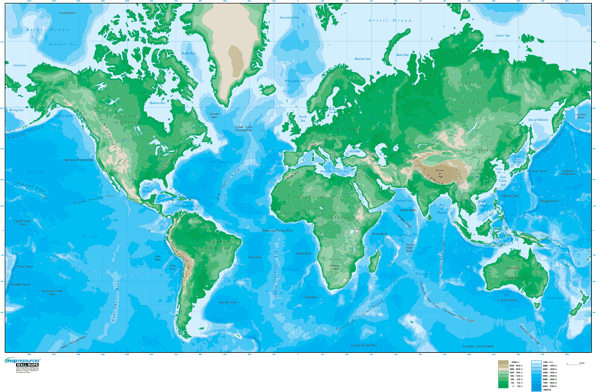
Educational Wall Maps - World
It is important to educate young Americans in the way that will best prepare them to take over governance of the USA. This includes immersing children with educational wall maps, and encouraging them to have an opportunity to become interested in the world. Most importantly, starting to do so at a young age. Think about encouraging geographical skills that could help the world and shop by grade level for Educational Wall Maps.

Do you agree that GIS will be the way of the future? How should we prepare our children for a technological world?